
What Retaking the CliftonStrengths (Strengths Finder) Assessment Taught Me About Showing Up for My Clients
I'll be honest with you. I was nervous to retake it.
I became a certified Gallup CliftonStrengths (formerly Strengths Finder) coach in 2017 and have been using the CliftonStrengths assessment with individuals, teams, and organizations ever since. I've coached hundreds of people through their results. I believe in this tool deeply.
And I was still scared my results would change.
I know this from coaching so many people over time, that we get attached to our strengths! They become part of how we see ourselves, how we introduce ourselves, how we make sense of our own story. So when life shifts, and it does, and you wonder if the assessment will shift with it, it can some but it doesn’t drastically shift over time.
I want to normalize that for you before we go any further.
If you've retaken the assessment and felt unsettled by any changing results, that reaction makes complete sense. It doesn't mean something is wrong with you. It might just mean you're in a different season.
What Is the CliftonStrengths Assessment and What Does It Actually Measure?
If you're new here, or if you've heard of this tool but never quite understood what it does, here's the short version.
CliftonStrengths was created by Dr. Donald Clifton, who started with a simple research question: what if we studied what was right with people?
His team researched over 400 themes of talent and narrowed them down to 34. The assessment measures those themes, specifically how you naturally think, feel, and behave. It's not a decision-making tool. It won't tell you what career is best suited for you. What it does is shed light on how you work best, and how you might go about searching for and performing in a role that fits.
It's not a personality box. It's not about your values or your motivations. It's about your natural wiring, and what you do with that wiring is where things get interesting. It’s about your behavior.
The equation looks like this:
Talent (a natural way of thinking, feeling, and behaving)
x
Investment (time spent practicing and developing that talent)
=
Strength (near-perfect positive performance in any given activity)
What I love most about this tool is what it doesn't do. It doesn't tell you who you are and lock the door. It opens a conversation. It gives you language, often language you've never had before, for what you do best and why.
Over 34 million people have taken this assessment worldwide, and it is used by over 90% of Fortune 500 companies. In my work with mid-career women, it has become the foundation for my coaching and conversations. It’s a powerful starting point, especially if you’re looking to move jobs or you’re evaluating your career.
Why I Use CliftonStrengths with Every Coaching Client
As a career coach, I work with women who are stuck. These are extraordinarily capable women. But they've spent so many years doing everything for everyone else that they've lost the thread back to themselves.
They're competent at a lot of things. But they can't tell you what they actually like doing anymore. They can't articulate what they're best at in a way that feels true and grounded, not just resume-polished.
CliftonStrengths gives them concrete language they didn't have before. By understanding and leveraging your strengths effectively, you can increase your chances of securing a role that aligns with your talents and brings real fulfillment. And when you can stand grounded in what you know to be true about yourself, that confidence shows up everywhere. In interviews. In negotiations. In the conversations where you finally start asking for what you actually want because you know why you want AND that you’ll be really good doing it too.
If you haven't taken it yet, you can access it directly through Gallup. You can choose the Top 5 report or the Full 34. I always recommend the Full 34 because the order and the context of all 34 themes tells a much richer story than the top 5 alone.
What Changed When I Retook It
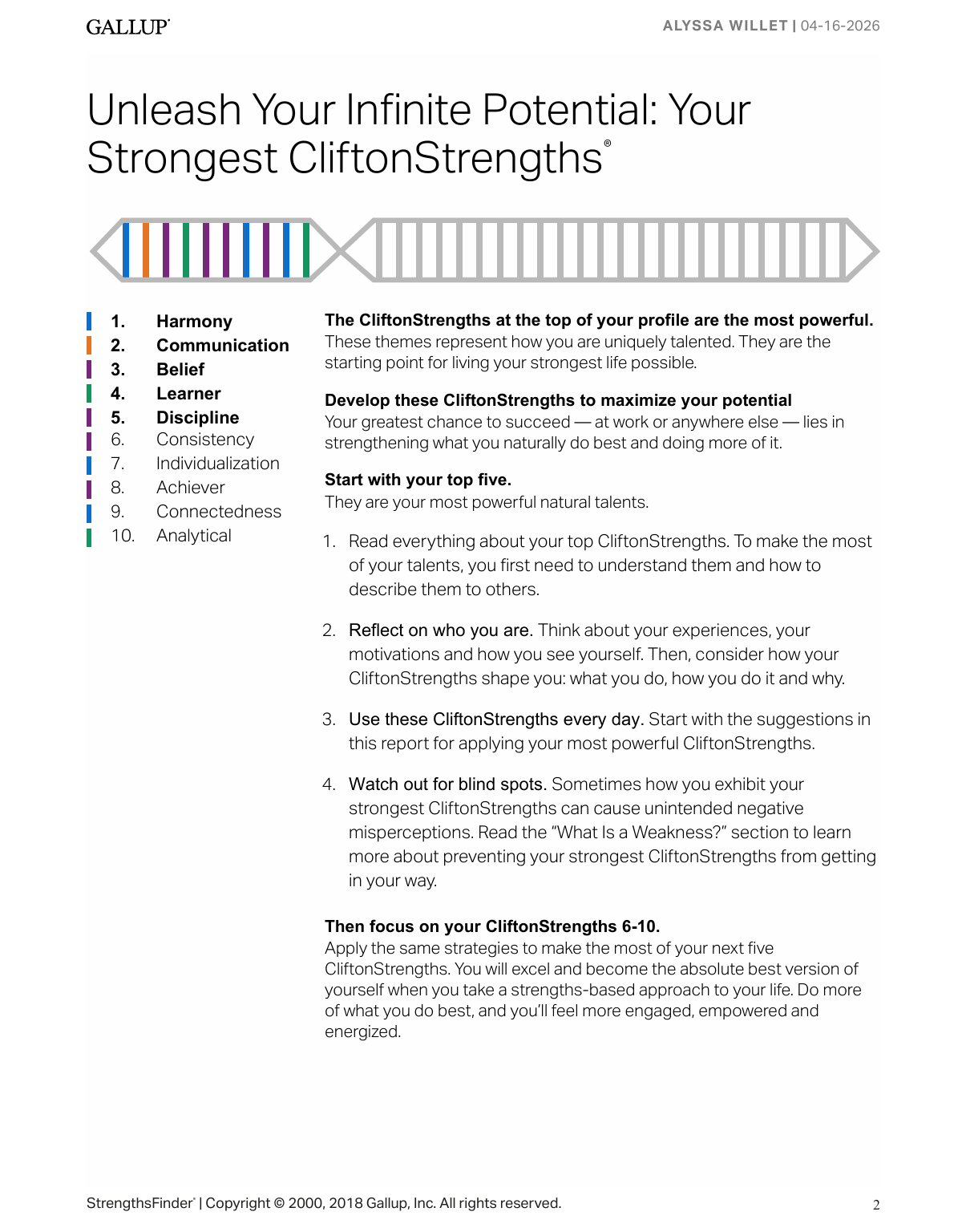
I took the assessment so long ago, and so much had changed in my life, that it was time. I upgraded to the Full 34 report and sat with my results.
My new top 5:
Harmony
Communication
Belief
Learner
Discipline
Some stayed. Some shifted. And one, Belief, surprised me enough that I had to sit with it for a while. But of course, I handed my report over to two other coaching friends and they validated immediately that they see so much of belief show up in the way I operate.
Here's what each one taught me about how I actually show up for the women I work with.
Harmony
Harmony means I am a proactive peace-maker. I think ahead about who is in the room, what friction might surface, and how to address it before it becomes a problem. In my coaching practice, that shows up as anticipating the fears and objections my clients haven't yet said out loud and creating space for them before we ever get there.
For my clients, this means they walk into a session braced for judgment. They've spent months, sometimes years, carrying something they haven't said to anyone. They expect to be told what they're doing wrong.
Instead they find a space where the mess is welcome. Harmony leading my profile means clients don't feel evaluated in my presence. And people cannot do real change work when they feel evaluated. I remove that barrier before the first session even ends.
Communication
I love this one, and I'm glad it stayed.
Communication means I care deeply about being understood. If something isn't landing, I want to find another way in. A metaphor, a story, a different frame, whatever it takes to make the idea click.
For my clients, this shows up in a specific way: I give people the words for what they're feeling. Most of the women I work with know something is wrong. They've been carrying a feeling without language for months, sometimes years. They can sense it but they can't name it.
I hand them the sentence. And when someone hears their own experience reflected back with clarity and precision, something shifts. That moment is often the turning point.
Belief
This one stopped me when it appeared.
I've always associated Belief with people who are immovable, so fixed in their convictions that there's no room for nuance. When I saw it in my top 5, my first reaction was resistance, which hello… if that doesn’t indicate some belief.
And then my fellow coaches basically laughed and said, "Alyssa. That's you."
They were right.
I am crystal clear that the work I do with women matters. Not in a vague, feel-good way. In a specific, certain, non-negotiable way. I believe that when women step fully into their leadership, in their careers, their homes, their communities, the world becomes more peaceful and more human. I believe women's voices change everything. And I believe none of that happens if women are still waiting for permission to want more.
That conviction didn't appear when I started Willet Coaching. It's the thread that runs through every role I've ever held, through higher education, Student Affairs, corporate HR, global biopharma leadership development. At every stage, the belief was the same: people are more capable than they've been taught to see, and I want to help them close that gap.
For my clients, Belief at number three means they feel my conviction before they can even make a case for themselves. When a woman has been told, implicitly or explicitly, that wanting more is ungrateful or selfish or unrealistic, she needs someone in her corner who believes without reservation that she is allowed to want more.
I am that person.
Learner
This one makes me a better coach than any credential ever could.
Learner means I cannot stop absorbing. Books, podcasts, frameworks, research, conversations, all of it. I am always bringing something new in, refining what I know, looking for the better question or the sharper tool.
For my clients, this means they are never getting a stale answer. I was studying something new last week that might be exactly what you need this week. That keeps the work alive in a way that experience alone never could.
Discipline
This is how I get things done.
Discipline means I thrive with structure. Systems, routines, follow-through. When I lean into it, I am organized, clear, and consistent in a way that creates real momentum. In fact, I wrote this post during the weekly writing block I protect on my calendar every week.
For my clients, Discipline at number five means I hold the container. Sessions start on time. Commitments are tracked. What you said you'd do gets followed up on.
That might sound administrative. But for the women I work with, it is deeply meaningful. Most of them are the most reliable person in every room they walk into. They rarely experience someone holding that same standard for them.
When I do, it signals something important: your growth is worth structure. This is not casual. You are worth showing up for.
What I Want You to Take From This
Your results can change. That's not a threat to who you are. It might just be an invitation to look at who you're becoming.
If you retook the assessment and feel unsettled by what shifted, that's worth exploring. If you've never taken it and you're curious what language it might hand you, that's worth exploring too.
And if you want to go deeper, to actually apply your results to your career, your job search, your next chapter, that's exactly what we do inside the Confident Job Search. CliftonStrengths is the foundation of all of it. Your confidence, your materials, and your story will finally reflect what you're actually good at.
Get on the waitlist now and let's build that together.
Have a great week. I'm cheering you on.
Alyssa
Alyssa Willet is an ICF-certified life and career coach and certified Gallup CliftonStrengths coach specializing in working with mid-career women stuck in soul-sucking jobs, figure out what’s next and design a life they love. Learn more at willetcoaching.com.
Frequently Asked Questions About CliftonStrengths/ Strengths Finder for Career Development
What is the CliftonStrengths assessment and how does it work?
CliftonStrengths is a talent assessment developed by Dr. Donald Clifton and Gallup that measures 34 themes of natural talent, specifically how you think, feel, and behave. You take an online assessment and receive a ranked report of your themes. The Top 5 report shows your strongest themes. The Full 34 report shows all themes in order, which gives a much richer picture of how you're wired. I always recommend the Full 34 for anyone doing serious career development work.
Can CliftonStrengths help me find a new job or change careers?
It won't hand you a job title, but it will give you something more useful: language. Most mid-career women I work with can't articulate what they're actually good at in a way that feels true, not just resume-polished. CliftonStrengths gives you that language. When you can speak clearly and confidently about what you do best, that shows up in interviews, in networking conversations, and in the way you evaluate opportunities. It becomes the foundation of a job search that actually fits.
Can your CliftonStrengths results change over time?
They can, but they often don't change dramatically. Research has shown the assessment's reliability: results from an initial test and retest are very similar, with the order of top strengths varying slightly. Gallup advises retaking it if you were distracted during the assessment, took it in a non-native language, or took it early in life and more than 10 years have passed. I retook mine after years of significant life and career change and found that most of my top themes held, with some meaningful shifts in order and one new theme that surprised me. If your results shift, that's not a loss. It's information.
Should I get the Top 5 or the Full 34 report?
The Full 34, always. The Top 5 gives you a starting point, but the full report shows you the complete picture of how your themes interact, which ones are supporting your top strengths from behind the scenes, and where your edges are. For career development and job search work especially, that context is everything.
How do I use my CliftonStrengths results in a job interview?
This is where most people get stuck. Knowing your strengths is one thing. Translating them into clear, confident interview language is another. Instead of saying "I'm a good communicator," you get to explain exactly how your Communication theme shows up, what it looks like when you're at your best, and how it moves work forward. That specificity is what makes you memorable and more importantly it makes you feel confident in your search and interviews. It's also what makes you sound like someone who actually knows herself, which is rarer than you'd think.